|
In this issue
|
| 🇬🇧 |
The October split, and which half is yours |
Compliance |
| 🇩🇪 |
Germany draws a line at €177,400 |
Compliance |
| 📅 |
Rule Watch: seven dates you can put in a calendar |
Dates |
| 🤖 |
Half of AI interviews run unsupervised. Some are illegal in the EU. |
Model Behaviour |
| 🔎 |
Three EORs for UK hiring, and where each falls short |
Shortlist |
|
|
Reading time, about four minutes.
|
|
|
Compliance
|
|
The UK’s October deadlines split in an awkward place
|
|
One date moved in July. If your plan was written before then, it has the wrong one in it.
|
Start with the correction. The new duty to take all reasonable steps to prevent sexual harassment, and the third-party harassment provisions alongside it, were originally set for 1 October 2026. The government’s updated Employment Rights Act roadmap, published 16 July, moved them to 30 October. Plenty of readiness plans written before the summer still say 1 October.
What does land on 1 October is the tribunal claim window, which doubles from three months to six. There is a transitional provision worth knowing: the six-month limit only applies where the act or failure being complained about happens on or after 1 October. For a series of acts, it is the last one that counts. Conduct before that date keeps the three-month window.
The 30 October package is the heavier one. Alongside the harassment duties come trade union access rights, recognition reforms and industrial action protections. Employers with fewer than 21 staff are exempt from the access rights.
Here is the part worth sitting with. Your EOR is the legal employer, so the tribunal change and the union machinery are theirs. The harassment duty is not, or not entirely. “All reasonable steps” is measured against how your managers actually run your team: what training you ran, how you handled the last complaint, whether anyone wrote it down. Third-party liability is the one that catches distributed teams. If your UK employee is on calls with your customers all day, the customer is the third party, and your provider has no visibility into those calls and no ability to control them.
One thing to do this week: email your provider and ask, in writing, which of the 30 October items they are taking on and which they expect you to handle. Get the answer before October, not after a complaint.
|
|
UK — what lands when, and with whom
|
| 1 Oct |
Tribunal claim window: 3 months → 6 months |
Provider |
| 30 Oct |
Harassment duty raised to “all reasonable steps” |
You |
| 30 Oct |
Third-party harassment liability begins |
You |
| 30 Oct |
Union access, recognition and industrial action reforms |
Provider |
| 9 Nov |
Scotland: breach of contract claims follow |
Provider |
|
|
|
Hiring in the UK through an EOR: full guide →
|
|
Affiliate partner · Rippling
|
|
Your UK hires may not need an EOR at all
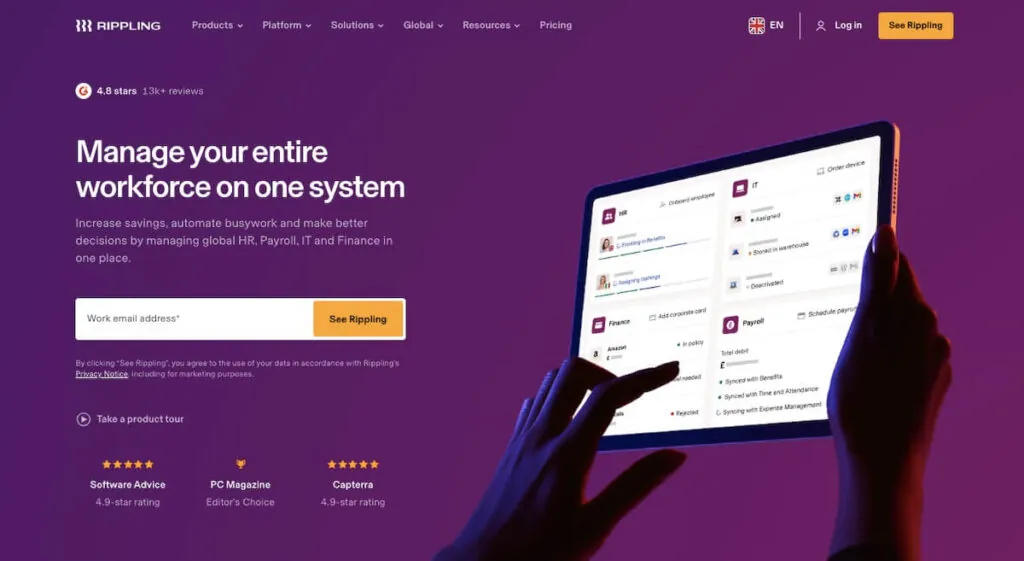
Rippling runs native payroll in the UK, US, Canada, Australia and India. If you already hold a UK entity, London hires sit on the same payroll rails and the same dashboard as everyone else, with no per-employee EOR fee on top. It is also the only platform in the category that procures, configures and ships MDM-enrolled laptops to 30+ countries and wipes them remotely at offboarding, with 650+ native integrations behind it. EOR pricing is quote-only, so budget for a sales call.
Read our Rippling review
|
|
|
Compliance
|
|
Germany draws a line at €177,400
|
|
The country everyone avoids over termination risk is considering an exit ramp for senior roles.
|
Germany’s governing coalition published a labour reform package in August. The change worth tracking: from 1 January 2027, employers would be able to dismiss employees earning above roughly €177,400 without the usual dismissal protection.
That threshold matters more than it looks. Dismissal protection is the single most common reason companies avoid hiring senior people in Germany, or route them through contractor arrangements that create their own problems. A senior engineer or country lead is often above that line. If this passes, the exit cost on exactly those roles drops.
Two caveats. This is a coalition package, not enacted law, and German labour reform has stalled at this stage before. And it changes nothing about the hires you make between now and then.
Worth a note in your 2027 headcount planning. Not worth restructuring anything yet.
|
|
Now
Dismissal protection applies regardless of salary. Terminations are negotiated, slow, and usually expensive.
|
|
Proposed, 1 Jan 2027
Above roughly €177,400, dismissal protection would not apply. Below it, nothing changes.
|
| Coalition package. Not yet law. |
|
|
Compare EOR providers by country →
|
|
Rule Watch
Seven things with dates attached.
|
| European Union AI Act transparency duties under Article 50 are live. They were not part of the Omnibus deferral. |
In force |
|
| United Kingdom Tribunal claim time limits double from three to six months. Applies to acts occurring on or after the date. |
1 Oct 2026 |
|
| United Kingdom Harassment duties, third-party liability, union access and recognition reforms. Moved from 1 October on 16 July. |
30 Oct 2026 |
|
| United Kingdom Scotland: breach of contract claims move to the six-month window. |
9 Nov 2026 |
|
| European Union Platform work directive transposition deadline. Brings in a rebuttable presumption of employment where control and direction are present. |
2 Dec 2026 |
|
| United Kingdom Unfair dismissal qualifying period drops to six months and the compensatory award cap is removed. Applies to dismissals from this date. |
Jan 2027 |
|
| Germany Dismissal protection relaxed above roughly €177,400. |
Proposed |
|
|
|
Model Behaviour
What AI is doing to the workplace, and where it runs into a border.
|
|
Half of AI interviews run unsupervised, and some of them are prohibited in Europe
A Resume.org survey of nearly 1,400 US workers, published 19 August, found 57% of companies already use AI somewhere in hiring. A third use it for interviews, and half of those let the AI conduct the interview directly with no human present. Some employers are using tools that analyse candidate language, assess tone, and collect facial recognition data.
Run that stack in the EU and part of it is not a compliance question, it is a prohibition. The AI Act bans inferring emotions from people in the workplace, and that ban has applied since February 2025. A tool that scores a candidate’s tone or facial expression is squarely in it.
The confusion comes from the deferral. Regulation (EU) 2026/1744, the Digital Omnibus on AI, entered into force on 27 July, six days before the original deadline, and pushed the Annex III high-risk obligations covering recruitment, promotion and termination from 2 August 2026 out to 2 December 2027. That is enacted law now, not a proposal.
But the deferral moved one block of the Act, not the Act. The Article 5 prohibitions were never in scope. Article 50 transparency duties applied from 2 August 2026 and are live today. So a company that heard “delayed” and stopped work may be running a banned tool right now, sixteen months before the deadline it thinks it is working to.
If a vendor tells you AI hiring compliance in Europe is a 2027 problem, that is the answer of someone who read one headline. Ask them specifically about Article 5 and Article 50.
|
|
The Shortlist
Three EORs worth considering for UK hiring, with the trade-off on each.
|

|
The UK sits inside Oyster’s Direct+ infrastructure, so there is no partner chain between you and the employment relationship. Every account gets a named CSM, and it is the only B Corp certified EOR.
The highest published rate in the category, and first-line support routes routine queries back to your CSM.
|
|

|
Published pricing at a little over half Oyster’s rate, with payroll that holds up better at scale than the budget tier. The sensible middle if you are hiring across several markets rather than one.
Around 20 native integrations, and a mixed owned-and-partner entity model, so confirm how your specific countries are served.
|
|

|
$199 flat across 185+ countries with no deposit and a named account manager at every tier. The cheapest serious option for a first UK hire.
A partner network rather than owned entities, and payroll reliability degrades past 30 to 50 employees across multiple countries.
|
|
|
| UK hiring |
Oyster |
Multiplier |
RemoFirst |
| Published rate |
$699 |
$400 |
$199 |
| Entity model |
Direct in UK |
Mixed |
Partner |
| Named contact |
Every tier |
Higher plans |
Every tier |
| Best fit |
Compliance first |
Scaling teams |
First hires |
|
|
Links may be affiliate links. These three are editorial picks and cannot be bought. Paid placements appear below, marked Featured.
|
|
Featured
Compare every EOR in one table
Entity ownership by country, pricing model, setup fees and what each provider actually covers. Updated as products change, and no vendor pays for placement in it.
Open the comparison →
|
|
|
Elsewhere
|
| Stat |
$199 to $699 per employee per month. That is the published spread across today’s three picks for what is, legally, the same function. (HRStacks) |
| Quote |
Resume.org’s Kara Dennison argues employers should tell candidates where AI is used in hiring, whether it recommends or rejects, how much human oversight sits behind it, and what data it collects. (via HR Dive) |
| Read |
Pinsent Masons maintains a running Employment Rights Act timeline covering 2026 and beyond. The clearest free tracker of what is confirmed and what is still moving. (pinsentmasons.com) |
|
|
That is Tuesday issue, we will be sending out a new issue on Friday
Forward this to whoever handles your international hires.
|
|
|

